Custom Web Development
Purpose-built websites and digital platforms shaped around your workflows, users and commercial goals—not forced into a pre-made template.

We develop secure, responsive websites, web applications and business platforms around the way your organization actually works. From a focused company website to a portal with custom roles, data and integrations, every build starts with clear requirements and ends with a maintainable technical foundation.
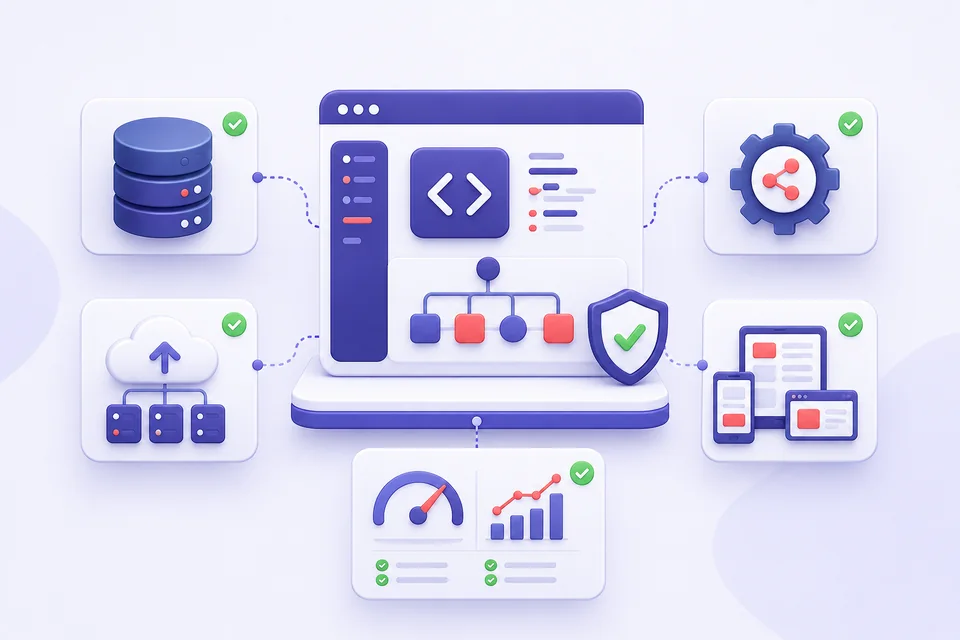
A website can look polished and still fail when its technical foundation is difficult to update, slow under real traffic or disconnected from the systems a business uses every day. Web development covers the code, data, integrations and architecture that make the experience work. It is where approved designs become responsive interfaces, content becomes manageable, forms reach the correct teams and business rules behave predictably.
Chulbul Design approaches development as a product decision. We first identify the users, actions, content, permissions and integrations involved. That lets us recommend a suitable build instead of adding complexity for its own sake. A straightforward service website may need a lean content management system. A customer portal may require authentication, role-based access, structured data and an API layer. Both deserve the same attention to clarity, testing and maintainability.
Our work combines frontend and backend development with practical communication. You see the scope, milestones and review points before launch. The result is a digital platform your users can navigate, your team can operate and future developers can understand.
Choose a focused service or combine the capabilities needed for a complete website, application or platform.
Purpose-built websites and digital platforms shaped around your workflows, users and commercial goals—not forced into a pre-made template.
Custom WordPress builds with manageable content, lean themes, practical plugins and a clean foundation for long-term maintenance.
Explore WordPress developmentResponsive interfaces built with semantic HTML, modern CSS, JavaScript and React where interactive application behavior is required.
Explore React developmentReliable server-side systems for business rules, authentication, content, payments, notifications and secure data processing.
Browser-based applications for teams and customers, including role-based access, workflows, dashboards and operational tools.
Secure self-service portals that help users manage accounts, requests, documents, bookings, orders or support from one place.
Flexible content systems for businesses that need structured publishing, permissions and easier day-to-day updates.
View CMS solutionsConnect your website with payment, CRM, logistics, messaging or internal systems through carefully designed API workflows.
Explore API integrationClear operational dashboards that turn business data into usable views, filters, reports and role-specific actions.
Move ageing websites and applications to a maintainable stack while protecting essential content, URLs and business continuity.
Plan a website migration
Templates and ready-made tools are useful when a requirement is standard. They become limiting when your users need a specific journey, your team follows a unique process or several systems need to exchange data. In those situations, custom web development creates the right behavior without forcing people to work around the software.
Discovery begins with the business flow: who uses the system, what each role can see, which action starts the process and what must happen next. We translate that flow into a practical technical plan covering interface states, data relationships, permissions, integrations and failure handling. The first release is scoped around the smallest version that can deliver genuine value, with later improvements kept visible on a roadmap.
The right format depends on the job users need to complete. These are common starting points, not fixed packages.
Structured, credible websites for established companies, service teams and multi-department organizations.
Lead journeys, service explainers and gated resources designed around longer business buying decisions.
Account areas for requests, files, service history, approvals, payments or support communication.
Availability, scheduling, confirmations and administrative controls adapted to your operating model.
Multi-role listing, enquiry and transaction flows for platforms that connect different user groups.
Secure content, subscriptions, permissions and account management for communities or professional networks.
Focused web tools that replace repetitive spreadsheets, fragmented forms and manual hand-offs.
Course, resource and progress experiences built around the needs of learners and administrators.
Structured editorial workflows for news, resources, guides and frequently updated content libraries.
Useful views of business data with filters, permissions, exports and decision-ready summaries.
A stable product needs more than a fashionable framework. We select technologies according to user experience, business logic, integrations, hosting and the people who will maintain the platform.
Frontend development controls what users see and how the product responds. We use semantic HTML, custom CSS and JavaScript for clear, responsive experiences, adding React when reusable components and richer application states justify it.
The backend manages data, permissions, forms, integrations and rules. PHP, Laravel and Node.js are used where they fit the application, team and deployment environment—not simply because a technology is popular.
For content-led sites, WordPress or Joomla can provide practical publishing tools. We structure fields, permissions and reusable components so editors can work efficiently without damaging layout or creating inconsistent pages.
Modern websites rarely operate alone. A lead may need to enter a CRM, a successful payment may need to update an order, or a booking may need to trigger confirmation messages. API integration connects those steps so information moves accurately and teams spend less time copying data between tools.
Before coding, we confirm the provider's documentation, authentication method, available endpoints and operational limits. We then define what should happen when a request succeeds, fails or arrives twice. This error-aware approach matters because a connection that works only during a perfect demo is not ready for real customers.
They cannot be reliably added as decoration at the end. We address them during planning, implementation and release.
Responsive image delivery, sensible asset loading, efficient code and reduced dependency weight help pages become usable sooner. We test key templates and investigate bottlenecks instead of relying on a single score.
Validation, access control, secure configuration and careful handling of credentials reduce avoidable risk. Security responsibilities are documented across the application, hosting and third-party services.
Reusable components, structured data and separation of concerns make future features easier to plan. We avoid premature complexity while keeping likely growth paths visible in the architecture.
Semantic structure, keyboard access, labels, focus states, contrast and meaningful interaction feedback help more people use the product and improve overall interface quality.
Each stage produces something reviewable, keeping decisions clear and reducing expensive surprises near launch.
We clarify audiences, user roles, business goals, content, integrations, constraints and what success should look like.
The solution is divided into features, data, architecture, milestones and acceptance criteria with risks made visible.
Approved flows and designs are checked against real states, responsive behavior and development requirements.
Frontend, backend and integrations are built in reviewable increments so feedback arrives while change is manageable.
We test supported devices, forms, permissions, links, content states, integrations and important failure paths.
Deployment, analytics, redirects, access and handover are checked before the project moves into support or planned iteration.
Our portfolio includes digital delivery experience connected with Gurjar Pragati Manch, Kisaan Jee and Tera Ghar. Relevant work can demonstrate how business requirements are translated into responsive interfaces, structured content, practical administration and maintainable digital systems.
During a project discussion, we explain our role and walk through the architecture, integrations, responsive behavior and quality checks that matter for a similar build. Chulbul Design can also collaborate with SoftLes as a technology partner when a project requires broader engineering support.
Review Selected WorkTechnical decisions affect customer experience, marketing, operations and future cost. We keep those connections visible instead of treating development as a closed coding exercise. You receive understandable explanations, clear review points and recommendations tied to the actual requirement.
Our Gurugram-based team serves businesses in India and international markets through planned remote collaboration. Meeting windows, milestones, responsibilities and feedback channels are agreed before work begins. This creates a practical working rhythm without pretending to have offices where we do not.
A useful estimate comes from a defined scope. We review these factors before recommending a budget and delivery plan.
Product scopeNumber of templates, workflows, user roles and administrative features.
Interface complexityCustom states, interactions, responsive behavior and accessibility requirements.
Data and integrationsExisting systems, APIs, migration volume and synchronization rules.
Quality requirementsTesting depth, security controls, performance targets and supported environments.
Delivery modelContent readiness, approval workflow, launch constraints and ongoing support.
Continue with the service that matches your immediate need.
Practical answers for teams comparing development partners and planning a new build.
Ask a project-specific questionA web development company plans and builds the technical system behind a website or web application. This may include frontend interfaces, backend logic, databases, content management, integrations, authentication, testing, deployment and ongoing technical support.
Web design defines how a digital experience looks, feels and guides users. Web development turns that experience into a working product through code, data, integrations and technical architecture. Most successful projects need both disciplines to work together.
Yes. When a project needs unique workflows, stronger performance or a distinctive interface, we build around its requirements rather than forcing it into a generic theme. For simpler content projects, we may recommend a carefully developed CMS solution when that is the better business fit.
Our confirmed development stack includes HTML, CSS, JavaScript, React JS, PHP, Laravel, Node.js, WordPress and Joomla. The final stack is selected after reviewing the product requirements, integrations, editing needs, hosting environment and maintenance plan.
Yes. We can build role-based web applications, customer portals, internal dashboards, booking workflows and other browser-based systems. Discovery is used to map users, permissions, data, integrations and the minimum useful first release.
Yes. We work with documented APIs for payments, CRM, messaging, analytics, shipping and other business services. Before development, we confirm API availability, access requirements, rate limits, webhooks, error handling and data-security responsibilities.
Cost depends on scope, number of user roles, interface complexity, content migration, integrations, data structure, security requirements and testing. After discovery, we provide a written scope with milestones so the estimate is tied to defined deliverables.
A focused business website can take a few weeks, while portals and custom applications usually require a longer phased delivery. Timing depends on requirements, content readiness, integrations and approval speed. We confirm a practical schedule after discovery rather than promising an arbitrary launch date.
Those requirements are considered throughout architecture, development and testing. We use responsive layouts, optimized assets, clean code, access controls, input validation and deployment checks. Final performance also depends on hosting, third-party scripts and ongoing content practices.
Yes. Support can cover monitored updates, backups, bug fixes, performance checks, small improvements and planned feature releases. The appropriate maintenance arrangement depends on the stack and how business-critical the system is.
Tell us what users need to do, what is not working today and which systems are involved. We will help you define a practical next step.


