
Website speed directly affects rankings, conversions and user experience. Google has used page speed as a ranking factor since 2010, and since the Core Web Vitals update, it is a significant ranking signal on mobile — where 80%+ of Indian website traffic originates. Beyond rankings, a 3-second load time causes 53% of mobile users to abandon the page before it even loads. Most Indian websites score between 20–50 on Google PageSpeed Insights mobile — not because the design is bad, but because common technical issues like unoptimised images, render-blocking scripts, missing caching and bloated plugins accumulate over time. We perform a comprehensive speed audit and implement every fix ourselves — you will see the improved score, not just a list of recommendations.
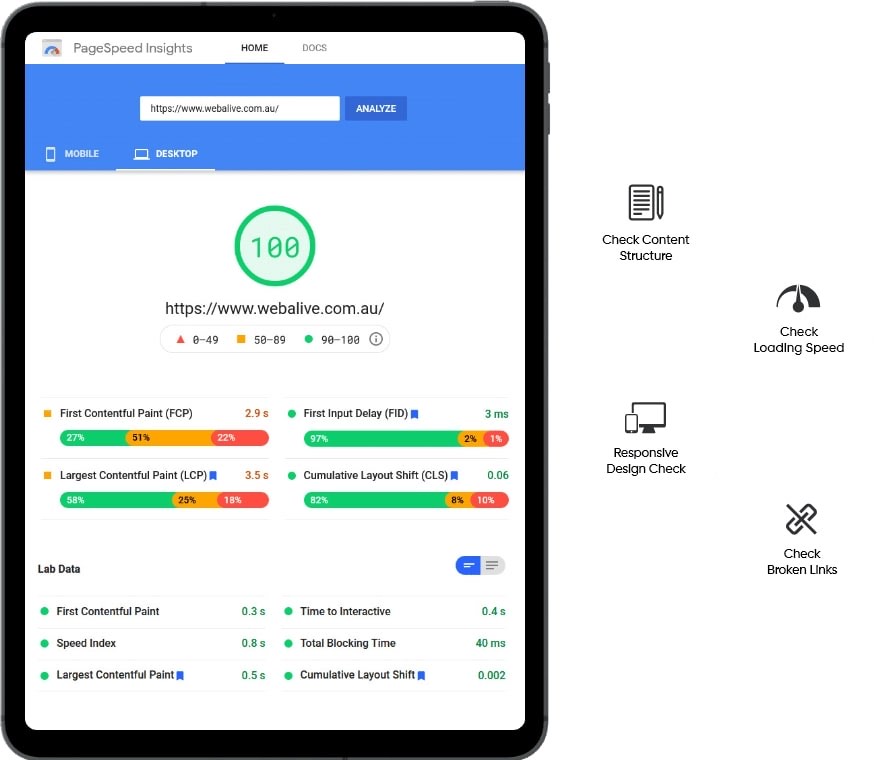
Image Optimisation — The Single Biggest Speed Win
Images are responsible for 50–70% of most website page weight. A typical Indian business website has hero images uploaded at 3MB–8MB, product images without compression, and no WebP conversion — causing every page to download megabytes of image data before rendering. We compress all images using lossless and lossy compression appropriate to the image type, convert all images to WebP format with JPEG/PNG fallback for older browsers, serve images at the correct display dimensions (not a 2000px image displayed at 400px), implement lazy loading for all below-the-fold images, and configure the LCP (Largest Contentful Paint) hero image with a preload hint so it starts loading before the HTML is fully parsed. Together, these image fixes alone typically improve PageSpeed mobile score by 15–30 points.
- WebP conversion with JPEG/PNG fallback
- Compression — lossless for logos, lossy for photos
- Correct dimensions — no oversized images displayed small
- Lazy loading for all below-fold images
- LCP hero image preload for fastest first paint
JavaScript, CSS & Render-Blocking Resource Fixes
After images, JavaScript and CSS are the next biggest speed problem. Render-blocking scripts in the <head> delay page rendering — the browser cannot draw anything until all blocking scripts finish loading. We audit every script and stylesheet on your page: unnecessary scripts are removed, critical CSS is inlined, non-critical CSS is deferred, third-party scripts (Google Analytics, Facebook Pixel, chat widgets, heatmap tools) are loaded with async/defer attributes so they do not block rendering. We also minify all CSS, JavaScript and HTML files to remove whitespace and comments, implement HTTP/2 on the server for multiplexed delivery, and where applicable, use a CDN (Content Delivery Network) to serve static assets from a location close to Indian users.
- Render-blocking resource elimination
- Async/defer for all third-party scripts
- CSS, JS and HTML minification
- Critical CSS inlining for above-fold content
- CDN implementation for Indian traffic


Server-Side Caching, TTFB & Database Optimisation
A fast front-end cannot compensate for a slow server response. TTFB (Time to First Byte) — the time between clicking a link and receiving the first byte of the page — is directly affected by server configuration and database query efficiency. We configure server-side caching (Redis or Memcached for dynamic pages, full-page caching for WordPress via LiteSpeed Cache or WP Rocket), optimise PHP-FPM settings for your traffic level, enable GZIP/Brotli compression on the server, and audit slow database queries using the MySQL slow query log. WordPress installations get database cleanup: post revisions limited, transients cleared, spam comments purged and table optimisation run to remove overhead from bloated databases.
- Server-side caching — Redis, Memcached or full-page cache
- GZIP/Brotli compression enabled on server
- Database optimisation and slow query audit
- PHP-FPM configuration for your traffic level
- Browser cache headers — long TTL for static assets
95+
PageSpeed Achieved
1.4s
Avg. LCP After Fix
200+
Sites Optimised
10+
Years Experience
Related Services
More ways we can help your business grow
Website Migration
Website Migration Services India | Zero Ranking Loss Migration – Chulbul Design
Website Security
Website Security Services India | Malware Removal & Security Hardening – Chulbul Design
Website Maintenance
Website Maintenance Services India | Monthly Website Support – Chulbul Design
Core Web Vitals Optimisation
Core Web Vitals Optimisation India | Fix LCP, INP & CLS – Chulbul Design
Ready to Grow Your
Business With Us?
Free consultation — tell us about your project and we'll get back within 1 hour.