
The Ultimate Guide to Travel Agency Website Design and Development
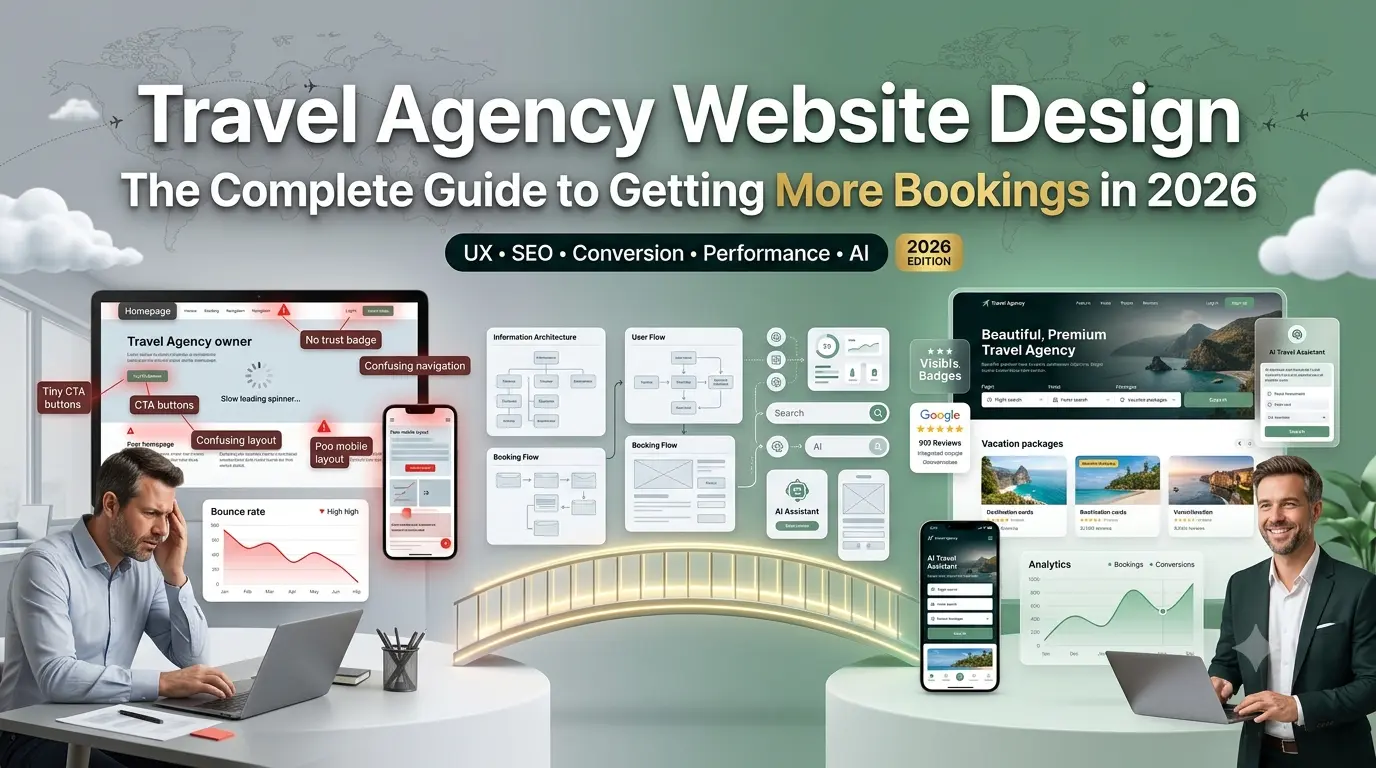
Introduction to Travel Agency Website Design
In today's digital age, your travel agency's website is often the first point of contact with potential customers. It's essential to create a website that not only showcases your brand but also provides a seamless user experience, builds trust, and ultimately drives bookings.
Why Your Website Matters More Than Ever
A well-designed travel agency website can make all the difference in attracting and retaining customers. With over 90% of leisure travelers starting their research online, your website is often the first impression a potential traveler gets of your agency.
I've seen numerous travel agencies lose bookings due to a slow, outdated, or confusing website. The traveler's expectation has shifted: they want Amazon-level convenience, Airbnb-style trust, and the reassurance of a local expert — all in one seamless digital experience.
It's crucial to understand that your website is not just a digital brochure; it's a tool that can help you build trust, establish your brand, and drive sales. A great travel agency website design should be built on seven pillars: trust, speed, branding, visual hierarchy, booking journey, accessibility, and SEO & content.
What Makes a Great Travel Agency Website?
A great travel website design is built on the following seven pillars:
- Trust. Real photos, secure badges, clear contact info, and authentic reviews — these signal legitimacy instantly.
- Speed. A fast site keeps visitors engaged. Core Web Vitals are direct ranking factors.
- Branding. Your site should feel like a cohesive extension of your agency's personality.
- Visual Hierarchy. Guide the eye from headline to CTA without confusion.
- Booking Journey. Simple, transparent, and forgiving — no one should struggle to give you money.
- Accessibility. Inclusive design reaches more travelers and improves SEO.
- SEO & Content. Helpful destination content attracts organic traffic and positions you as an expert.
Essential Features Every Travel Agency Website Needs
Based on dozens of audits, the following are the non-negotiables for a high-converting travel agency website:
- Advanced Search & Filtering – by destination, date, price, trip type.
- Detailed Destination Pages – rich with guides, photos, and local insights.
- Integrated Booking Engine – seamless, native experience.
- Lead Capture Forms – prominent but not annoying.
- Click-to-Call & WhatsApp – immediate contact options.
- Interactive Maps – visualize itineraries.
- Customer Reviews & Testimonials – video is gold.
- FAQs – reduce pre-booking anxiety.
- Blog / Travel Guides – SEO power and authority.
- Secure Payment Gateway – multiple options, trust badges.
- Live Chat – qualify leads instantly.
- Personalization – dynamic recommendations.
Travel Website UX Best Practices
Good travel website UX removes friction. Here's how the best sites do it:
Information Architecture & Navigation
Organize content so a first-time visitor can find "family safaris in Kenya under $5,000" in two clicks. Use clear, conventional labels — never clever jargon.
Search & Filtering
Implement faceted search with real-time results. Speed is critical; use debounced input and loading skeletons.
Booking Flow Simplicity
Reduce steps: select dates → passenger details → payment. Show a progress bar, allow guest checkout, and persist data. This is travel booking UX at its core.
Mobile-First Design
Design for thumb zones. Buttons must be at least 44×44px. Test on real devices, not just emulators.
Micro-interactions & Psychology
Subtle hover states, success animations, and scarcity indicators ("Only 2 spots left") nudge users toward booking while building trust.
Expert Tip: Run a 5-second test: show your homepage to someone new for five seconds, then ask what they remember. If your value proposition isn't clear, redesign the hero.
Homepage Design Best Practices
Your homepage must instantly answer: "What do you offer, and why should I trust you?"
Homepage Must-Haves
- Strong hero headline with unique value proposition
- Prominent search form (destination, dates, travelers)
- Popular destinations / featured trips with visual cards
- Trust badges (ASTA, IATA, Google rating) above the fold
- Real testimonials with names and photos
- Clear primary CTA ("Get Your Custom Itinerary")
- Footer with contact info, quick links, and newsletter signup
The Travel Booking Flow: Step by Step
A flawless travel booking website flow looks like this:
- Search – intuitive, with autocomplete.
- Results – clean cards, sortable, with price and availability.
- Filters – refine by duration, budget, activity level.
- Trip Details – itinerary, inclusions, photos, reviews.
- Passenger Details – minimal fields, clear error validation.
- Add-ons & Upgrades – optional, never forced.
- Payment – secure, transparent, multiple methods.
- Confirmation – summary, next steps, and a warm thank you.
"We cut our booking steps from 7 to 4 and saw a 40% increase in completed bookings within two months. Simplicity is the ultimate sophistication." — Maria Chen, Owner, Pacific Wave Travel
Travel Website SEO: A Practical Guide
Travel website SEO isn't magic — it's methodical. Key areas:
- Local SEO: Optimize Google Business Profile, build local citations.
- Content Strategy: Publish comprehensive destination guides targeting long-tail keywords.
- Technical SEO: Clean URL structure, schema markup (Tour, FAQ, LocalBusiness), XML sitemap.
- Internal Linking: Connect blog posts to relevant tour pages.
- Core Web Vitals: Achieve "good" thresholds across LCP, INP, CLS.
Website Performance Optimization
| Metric | Target | Impact |
|---|---|---|
| LCP | < 2.5s | Perceived load speed |
| INP | < 200ms | Interaction responsiveness |
| CLS | < 0.1 | Visual stability |
Use a CDN, compress images to WebP, implement lazy loading, and minify assets. These steps alone can shave seconds off load time.
Website Security & Compliance
Travelers share sensitive data. Your travel website development must include SSL, PCI compliance for payments, GDPR/cookie consent, and a clear privacy policy. A padlock icon isn't optional — it's expected.
AI in Travel Website Design
AI is reshaping travel agency web design with intelligent chatbots, AI trip planners, predictive search, and personalized recommendations. An AI-powered concierge can qualify leads 24/7, suggesting itineraries based on natural language input — a genuine differentiator.
Travel Website Design Trends for 2026
- Glassmorphism & Soft Gradients – frosted glass effects that feel modern.
- Dark Mode – a must for contemporary UX.
- Micro-animations – subtle motion that delights.
- Voice Search Optimization – for conversational queries.
- Hyper-Personalization – dynamic content based on behavior.
- Minimalism – less clutter, more focus.
Travel Agency Website Checklist
- Clear value proposition in hero
- Fast load time (LCP < 2.5s)
- Mobile-responsive with thumb-friendly UI
- Advanced search with filters
- SEO-optimized destination pages
- Streamlined booking flow (≤4 steps)
- Real testimonials and trust badges
- Live chat or WhatsApp integration
- Accessible design (contrast, alt text)
- Schema markup for rich results
- Active blog with helpful content
- Google Business Profile optimized
Common Travel Website Mistakes
The following are common mistakes to avoid when designing a travel agency website:
- Slow Site: Bounce rate skyrockets. Fix: compress images, upgrade hosting.
- No Mobile Optimization: 60%+ traffic lost. Fix: responsive, mobile-first.
- Weak CTAs: Nobody books. Fix: action-driven, specific buttons.
- Hidden Pricing: Erodes trust. Fix: show sample prices.
- Broken Booking Flow: Abandoned carts. Fix: simplify, guest checkout.
- No Social Proof: Lack of credibility. Fix: video reviews, partner logos.
- Ignoring SEO: Invisible online. Fix: content hubs, technical SEO.
- Cluttered Navigation: Users get lost. Fix: 5-7 clear menu items.
If you're weighing these factors for your own project, that's the kind of decision we help with at Chulbul Design.
Frequently Asked Questions
How much does a professional travel agency website design cost?
Custom travel agency website design with booking integration typically ranges from $8,000 to $35,000, depending on complexity and features. The ROI from increased bookings quickly offsets the investment.
How long does a travel website redesign take?
A comprehensive travel website redesign takes 8–16 weeks, including strategy, design, development, and testing. Rushing leads to a site that looks new but fails to convert.
Do I need a custom booking engine?
Most agencies successfully integrate platforms like FareHarbor or Rezdy. The key is a seamless experience that feels native to your travel booking website.
What platform is best for a travel website?
WordPress remains popular for flexibility, Webflow for design freedom, and custom headless builds for scalability. The best travel website development choice depends on your specific needs.